
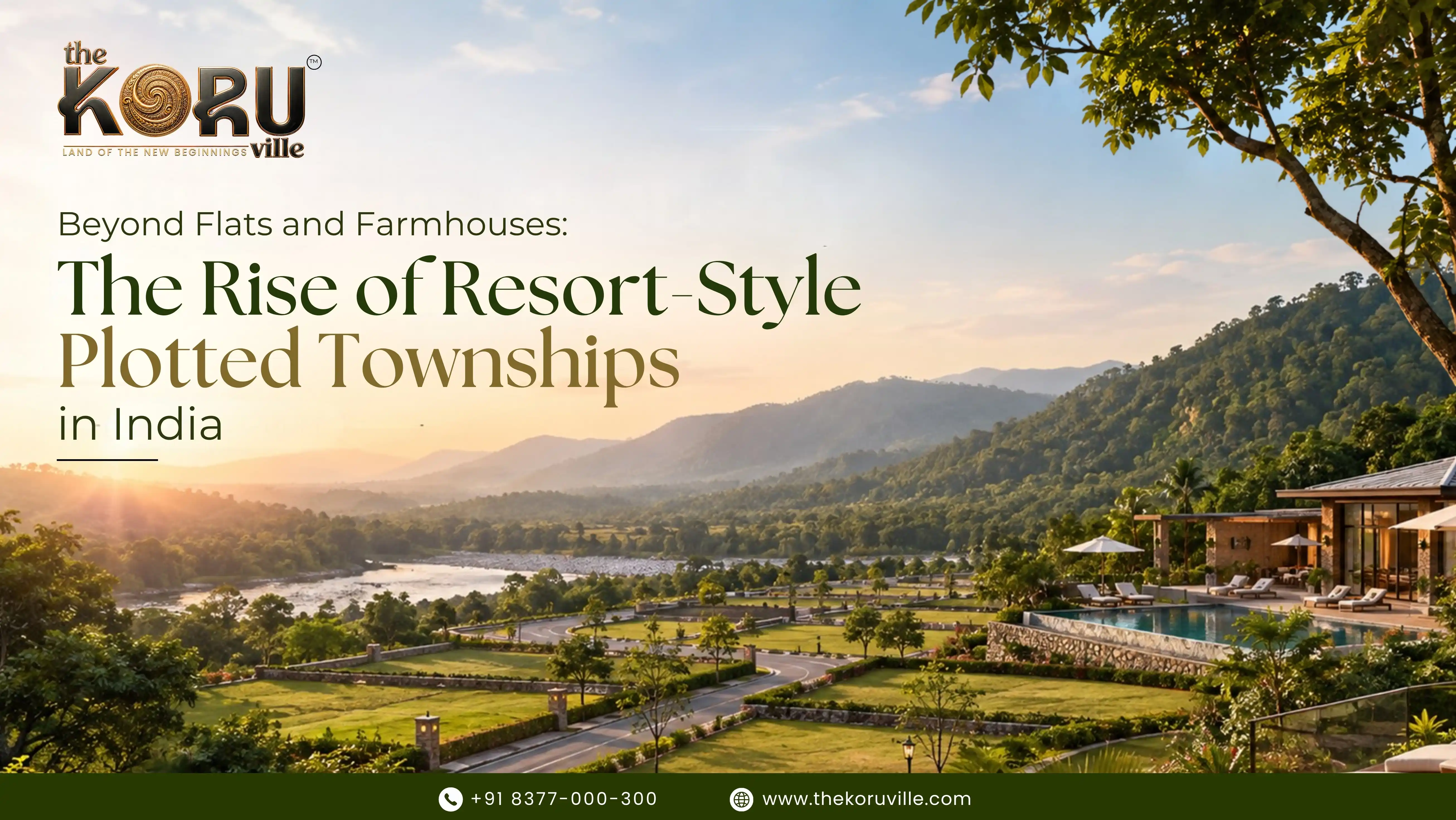
A resort-style plotted township is a planned residential community where buyers purchase individual plots within a boundary-walled layout that also includes shared amenities such as a clubhouse, landscaped common areas and managed internal roads. It sits between two formats Indian buyers already know well: the urban flat, where you own a unit inside someone else's building, and the standalone farmhouse, where you buy land and manage everything on it yourself. This format combines the parts of each that buyers tend to value most: direct land ownership, and a managed, amenity-rich setting that doesn't ask the owner to build every piece of infrastructure alone.
To make this concrete, this piece looks at how the category works in practice through The Koru Ville, a resort-themed plotted development near Jim Corbett National Park in Uttarakhand, based on details published on the project's own page. What's on offer there is land — resort-themed plots within a planned, amenity-equipped community — with an associated design plan for owners who choose to build a private villa in Uttarakhand.
What a Resort-Style Plotted Township Actually Is
The phrase gets used loosely, so it helps to be specific about what typically distinguishes this format from other rural or semi-rural property types.
A plotted township is, first, a planned layout. Instead of buying an undivided piece of agricultural or rural land and arranging access and utilities independently, buyers get a demarcated plot within a layout that already has internal roads, defined plot boundaries and, in stronger projects, utility connections either in place or on a stated rollout.
Second, it's gated. A boundary wall and controlled entry are close to standard for this category, offering a level of security and privacy that a standalone rural plot typically doesn't.
Third, it's amenity-led. This is the "resort-style" part. Common facilities — a clubhouse, walking or jogging trails, landscaped gardens, sometimes a shared pool or play area — are built and maintained at the community level, giving every owner access to more than they'd typically build for themselves on a single plot.
Fourth, the core product is the plot. What varies between projects is what comes attached to it — in some cases just the boundaries and community infrastructure, in others a design plan owners can follow when they're ready to build, so that the community develops a consistent, cohesive character over time.
Why This Format Has Been Gaining Attention
A few genuine shifts in buyer behaviour help explain why this category has grown, particularly around weekend-home markets near major Indian cities — the Lonavala-Alibaug belt near Mumbai, parts of Coorg and Chikmagalur near Bengaluru, and hill and Terai corridors near Delhi-NCR are commonly cited examples in real estate commentary.
Hybrid and remote work has changed what a second home needs to do. A property once meant purely for occasional holidays now sometimes doubles as an occasional workspace, which raises expectations around comfort and reliability.
Buyers increasingly want land ownership without the full weight of land management. A farmhouse offers a large plot and full control, but also full responsibility for security, water, road access and upkeep, often from a distance. A managed plotted community shifts much of that operational load to a community structure.
Interest in an investment in resort-style property has grown alongside interest in more conventional real estate. For some buyers, land within a managed, amenity-led community feels like a more tangible middle ground than a financial instrument, while still requiring the same care around documentation and realistic expectations as any property purchase.
These are observed shifts in what buyers say they want, offered as general analysis rather than a projection of future prices or resale demand for any specific market.
Resort-Style Plotted Township vs Farmhouse vs Flat
| Factor | Flat | Farmhouse | Resort-style plotted township |
|---|---|---|---|
| What you buy | A unit plus undivided share of common areas | Land, plus whatever structure you build | A plot, within a gated, amenity-equipped layout |
| Land ownership | Indirect (through a housing society) | Direct | Direct plot ownership |
| Security | Depends on building/society | Owner's responsibility | Typically boundary-walled, managed entry |
| Amenities | Vary by building | None unless self-built | Clubhouse, trails, pools, play areas — usually included |
| Design | Fixed by the building | Fully owner's choice | Often guided by a shared design plan for a consistent community look |
| Typical location | Urban/suburban | Rural, often distant from services | Semi-rural, often near tourism or nature destinations |
Each format suits a different priority. A flat suits buyers who want convenience and don't mind shared decision-making. A farmhouse suits buyers who want complete control and don't mind the workload that comes with it. A resort-style plotted township is aimed at buyers who want direct land ownership together with shared amenities and a managed community setting.
A Closer Look: The Koru Ville in Kilawali, Uttarakhand
The Koru Ville is a resort-style plotted township at Kilawali, a village on the Kashipur–Jim Corbett road in Udham Singh Nagar district. What's on offer is resort-themed plots, sold in three defined categories, within a gated community near Jim Corbett National Park — a setting that pairs a genuine nature-facing location with the infrastructure of a planned development.
What the Name Means
According to the project, the name "Koru" comes from Māori culture, referring to the spiral shape of a young silver fern frond as it unfurls — used there to represent new growth and new beginnings. The project frames its overall identity around this idea, positioning itself as a place for a fresh start away from city routines rather than simply another land parcel near a national park.
A Single Design Language Across the Community
One detail worth understanding about The Koru Ville specifically: the project states that every villa built within the community follows the same resort-style design language — consistent rooflines, courtyards and shaded sit-outs, intended to read as one cohesive place rather than a mix of individually styled homes. This is the practical purpose behind the design plan attached to each plot category, and it's a meaningful point of difference from plotted developments where each owner builds to their own, unrelated design.
Location and Connectivity
According to the project's own listing, the site sits roughly 15 minutes by drive from Phato Gate, one of Jim Corbett National Park's safari entry points, described as accessible year-round rather than only in peak season.
| Destination | Approximate distance/time (as stated by the project) |
|---|---|
| Phato Gate, Jim Corbett National Park | ~15 minutes by drive |
| Tumaria Dam | Within walking distance |
| Ramnagar town | ~22 km |
| Ramnagar Railway Station | ~23 km |
| Kashipur town | ~20 km |
| Kashipur Junction (railway) | ~20 km |
| Gaushala Railway Station | ~11 km |
| AIMS Hospital | ~34 minutes by drive |
| Nainital | ~56 km |
| Pantnagar Airport | ~66 km |
| Delhi NCR | Reachable by road within a day |
These figures come from the developer's project page, so readers planning a visit should confirm current drive times themselves as part of that trip.
What Buyers Purchase: Resort-Themed Plots in Three Categories
The offering is structured around three plot sizes, each carrying its own name within the project's resort identity, with an associated design for a luxury villa in Uttarakhand attached to each.
| Category | Plot Size | Plot Area | Built-Up Area | Layout | Pool |
|---|---|---|---|---|---|
| Mayoora | 111 sq. yd | 1,000 sq. ft | 1,390.3 sq. ft | Living area, one bedroom, dresser and washroom on each floor | Private plunge pool (8' x 8') |
| Mriga | 125 sq. yd | 1,125 sq. ft | 1,426.8 sq. ft | Same duplex structure at a slightly larger scale | Private plunge pool (9' x 7') |
| Simha | 139 sq. yd | 1,250 sq. ft | 1,589.5 sq. ft | Two bedrooms and two washrooms on the ground floor; a third bedroom, an additional washroom and a large open terrace on the first floor | Private swimming pool (10' x 7') |
Each design is a Ground + First Floor layout. Mayoora and Mriga are described with a plunge pool sized for relaxing rather than swimming laps, while Simha is the only category with a full private swimming pool. All three include access to a common swimming pool and a dedicated play area shared across the community, alongside whatever private pool comes with the chosen category.
For anyone weighing what a private villa in Uttarakhand could look like on one of these plots, this gives a concrete reference: a defined layout, built-up area and pool specification tied to each category, rather than an open-ended promise.
Shared Community Features
Beyond the individual plots, the development includes shared infrastructure and amenities: parking, rainwater harvesting, a consistent resort-themed architectural plan across the community, security and CCTV surveillance, garden and landscaped areas, a clubhouse, water supply, a children's play area, a jogging track, and a common swimming pool available to residents.
A Path Toward Passive Income in India, With Clear Conditions
For owners who go on to build, the project describes an arrangement relevant to anyone exploring passive income in India through property: a set number of personal-use days each year, with the villa available for guest bookings the rest of the time — holidays, weekend stays, events. Under this model, the developer states it provides a fixed rental payout to the owner as per agreed terms, and separately handles maintenance and upkeep, which can make ownership considerably less hands-on for owners who don't live nearby.
As with any managed rental arrangement marketed around passive income, the specific numbers matter more than the concept. The project's own materials note that rental income, occupancy and payouts are subject to the final agreed terms and applicable conditions, so buyers interested in this option should ask for the exact usage-day allocation and payout structure in writing, as part of standard, careful planning for any second-home purchase. No rental figure should be treated as guaranteed unless it's written into the signed agreement.
Land Status and Registration
The project states that land in the Kilawali belt has undergone conversion from agricultural to residential use, supporting planned residential development in the area. RERA registration for The Koru Ville has been applied for and is described as in progress, which is a normal part of a developing project's timeline. Buyers are welcome to check the official Uttarakhand RERA portal for the current status as part of their own due diligence, as they reasonably would for any property purchase.
Who This Kind of Property Tends to Suit
Based on the project's own description of its intended buyers, this format tends to draw weekend-home seekers from Delhi-NCR and nearby cities, frequent visitors to Jim Corbett who'd rather own a base near the park than book accommodation repeatedly, families planning a shared holiday property, non-resident Indians looking for a documented land asset in India, and buyers weighing a longer-term investment in resort-style land in a developing corridor.
What This Example Illustrates About the Broader Category
The Koru Ville sells plots attached to a resort-theme design plan, which is one specific way to run a resort-style plotted township — not the only one. Some projects in this category simply sell demarcated plots and leave construction entirely open to the owner. Others, like this one, attach a defined design plan to each plot category and apply it consistently across the community, giving buyers a clear reference point for what the development is working toward.
Both approaches have their own strengths. An open design gives buyers more freedom over construction cost, timeline and style. A guided, single design language offers a clear, ready blueprint and helps a community build a cohesive identity over time. Buyers comparing options across this category should simply be clear on what a specific project's design plan represents, and confirm that directly with the project team.
Practical Considerations for Buyers Evaluating a Project Like This
Understand the design plan's role. Ask how the plot purchase relates to the attached villa design, and on what timeline construction is expected, if at all.
RERA status. Ask for the current registration timeline and check the official state portal, as a normal step in any property purchase.
Cost planning. Get a clear, written breakdown of what the plot price covers, and what construction, interiors and decoration would involve separately if and when you choose to build.
Rental and passive income terms. If a managed rental arrangement interests you, request the exact terms in writing — personal-use days, payout structure, and any conditions that could affect them.
Land classification and title. Verify the agricultural-to-residential conversion status and the title chain for your specific plot as part of standard due diligence.
Site visit timing. Visiting in more than one season, including during the monsoon, gives a fuller picture of the land and access roads throughout the year.
The Short Version
A resort-style plotted township offers a middle path between a flat's convenience and a farmhouse's independence, and The Koru Ville is a plot-first version of that idea: resort-themed plots in one of three categories, within a gated, amenity-equipped community near Jim Corbett, with a consistent design language on hand for owners planning a future luxury villa in Uttarakhand, and an optional route toward passive income in India for those who choose to build and rent. As with any land purchase, the details that matter most are the ones specific to the plot and the agreement — RERA status, the design plan's exact role, and any rental terms — all worth confirming directly with the project team as part of a considered, well-informed purchase.
FAQ SECTION
1. What does The Koru Ville sell — plots or villas?
The core product is resort-themed plots, sold in three categories. Each plot comes with an associated design plan for a future villa, giving buyers a clear reference for what they could eventually build.
2. What does the name "Koru" mean?
It's a Māori word describing the unfurling spiral of a young silver fern frond, used by the project to represent new growth and new beginnings.
3. Are all the villas in the community built to the same design?
Yes, according to the project. Every villa follows the same resort-style design language, so the community has a consistent, cohesive look rather than a mix of individually styled homes.
4. Is The Koru Ville RERA registered?
Registration has been applied for and is described as in progress, which is typical for a project at this stage. Buyers are welcome to check the official Uttarakhand RERA portal for the current status.
5. Can a villa here generate passive income in India for the owner?
The project describes an arrangement where owners get a set number of personal-use days each year, with the villa available for guest bookings the rest of the time, and the developer handling maintenance and paying an agreed amount. Exact terms should be confirmed in the signed agreement, and no figure should be treated as guaranteed unless it's contractually specified.
6. How far is The Koru Ville from Jim Corbett National Park?
The project states it is approximately 15 minutes by drive from Phato Gate, one of the park's safari entry points, described as open year-round.
7. What's the difference between the three plot categories?
Mayoora (111 sq. yd), Mriga (125 sq. yd) and Simha (139 sq. yd) differ in plot size, built-up area and layout, with Simha being the largest and the only category with a full private swimming pool rather than a plunge pool.
8. Is a resort-style plot a good investment in resort property, or mainly a lifestyle purchase?
It depends on individual goals. Many buyers approach this as a long-term land and lifestyle purchase first, valuing the location and planned community setting, while confirming specific terms around any future construction or rental arrangement directly with the project before treating it as an income-generating investment.